PostgreSQL vs ClickHouse: Which Database Fits Your Product and Analytics
Direct answer: Choose PostgreSQL when you need a general-purpose ACID relational database for transactional workloads, complex joins, and application-integrated business logic. Choose ClickHouse when you need a high-throughput, columnar analytical engine built for fast ad-hoc aggregation over large event or metric streams. Many teams run both: PostgreSQL for OLTP and ClickHouse for OLAP, using an ingestion or ETL layer to move curated data for analytics.
Overview: different design goals, complementary roles
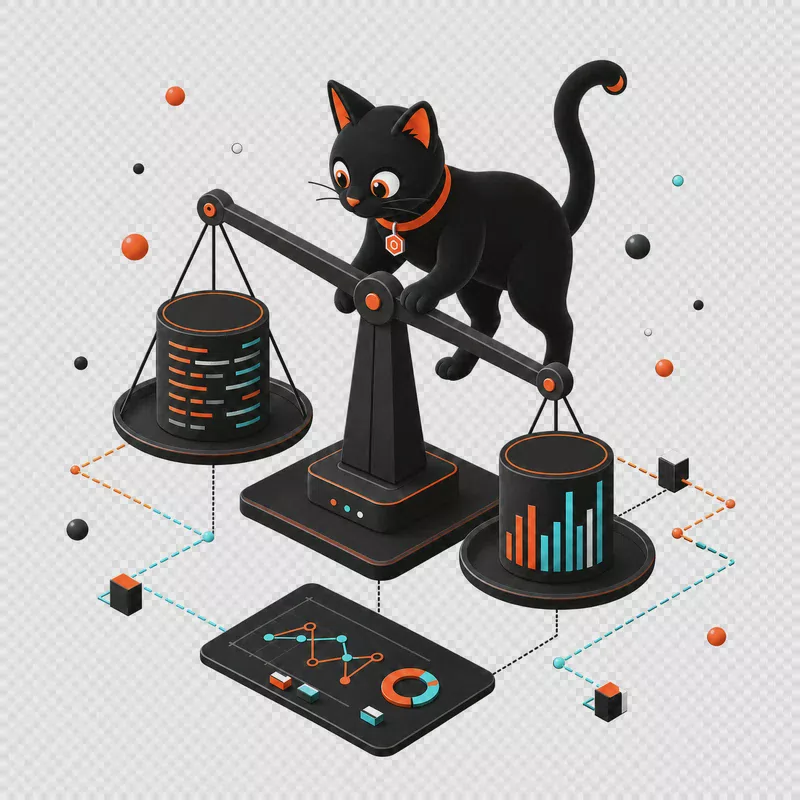
PostgreSQL is an open-source, general-purpose relational database with strong transactional guarantees, extensibility, and support for complex SQL and indexes. ClickHouse is a column-oriented database designed for fast analytics on large data volumes with vectorized execution and efficient compression. They target different points on the OLTP–OLAP spectrum: PostgreSQL prioritizes correctness and transactional features; ClickHouse prioritizes read performance for aggregation queries.
Both can be part of a modern data architecture. The decision is not a binary "winner": it depends on workload patterns, query types, data freshness needs, operational constraints, and team skills.
Key technical contrasts
| Dimension | PostgreSQL | ClickHouse |
|---|---|---|
| Data model | Row-based relational, ACID transactions, complex joins, constraints, stored procedures | Columnar, optimized for analytic scans and aggregations; weaker transactional semantics focused on append/merge workloads |
| Use case emphasis | OLTP, transactional product databases, operational features | OLAP, event analytics, time-series and metrics, large-scale aggregations |
| Indexing | B-tree, GiST, GIN, BRIN; good for selective point lookups and complex predicates | Limited traditional indexing; partitioning and primary key used for data skipping; design favors full-scan or vectorized aggregation patterns |
| Latency/throughput trade-off | Lower-latency transactional reads/writes; single-row operations efficient | Extremely high throughput for scans; very fast aggregations across millions/billions of rows when queries match columnar patterns |
Cite: PostgreSQL documentation describes its design intent and features; ClickHouse comparison material highlights columnar, OLAP orientation.
When PostgreSQL is the better fit
- You need strict ACID transactions, foreign keys, constraints and complex application-side data integrity.
- Your workload is dominated by many small reads/writes or interactive OLTP access patterns.
- You require rich SQL features, stored procedures, advanced indexing, or extensions (PostGIS, full-text search).
- You want a single system to both serve your product and support light analytics (small reporting queries).
Operational considerations: PostgreSQL has mature tooling for backups, replica streaming, logical replication, and broad ecosystem integrations. It fits well where schema evolution and transactional correctness matter.
When ClickHouse is the better fit
- You need fast, ad-hoc aggregation over very large datasets (event logs, telemetry, metrics).
- Queries are columnar-friendly (SELECT with aggregates, GROUP BY, time-window analyses).
- You can tolerate eventual consistency between transactional source and analytics store, and you accept append/merge-oriented ingestion models.
- Cost optimization for analytical queries matters: ClickHouse’s compression and storage layout reduce I/O for aggregations.
Operational considerations: ClickHouse often requires different operational patterns—data partitioning, TTLs, compaction tuning, and attention to ingestion pipelines to maintain freshness and schema alignment.
Two practical comparison tables
Table: Typical workload signals
| Signal from product/analytics needs | Prefer PostgreSQL | Prefer ClickHouse |
|---|---|---|
| Per-user transactional consistency and multi-row ACID updates | ✓ | |
| High-cardinality ad-hoc aggregations over event streams | ✓ | |
| Complex referential integrity and normalized schema | ✓ | |
| Millisecond single-row lookup at scale | ✓ | |
| Fast roll-ups and time-series analysis across months of data | ✓ |
Table: Operational trade-offs
| Area | PostgreSQL | ClickHouse |
|---|---|---|
| Operational complexity | Mature, many managed offerings, predictable | Requires attention to partitioning, merges, and resource isolation for heavy queries |
| Backup & restore | Point-in-time recovery, logical/physical backups | Snapshots and parts; approaches differ from row stores, planning required |
| Scaling model | Vertical + read replicas; sharding via Citus or custom | Native distributed shards and replicas; architecture optimized for distributed OLAP |
| Schema evolution | ALTER TABLE with rich features; migrations common | Schema changes can be heavier; best to design for append/merge and controlled evolution |
Practical decision framework / checklist
Use this checklist to decide, in order:
- Is transactional ACID correctness and referential integrity required by your application? If yes → PostgreSQL.
- Are your analytics queries dominated by aggregations over large event/metrics tables? If yes → ClickHouse.
- Do you need sub-second single-row writes and reads as part of user-facing flows? If yes → PostgreSQL.
- Can you accept a pipeline that extracts, transforms, and loads (ETL/streaming) data from your transactional store into an analytical store with some latency? If yes → ClickHouse is feasible for analytics, with PostgreSQL as the source of truth.
- What is your team's skillset and operational capacity? If experienced in relational DB operations, PostgreSQL reduces learning curve. If you have analytics engineers comfortable with columnar behavior and distributed query planning, ClickHouse is viable.
- Cost and scaling model: estimate operational cost for data retention and heavy queries — ClickHouse often reduces compute for scans; PostgreSQL may require sharding/derivatives for large-scale analytics.
- Plan for observability and maintenance: index and vacuum management for PostgreSQL; partitioning, merges, and TTL management for ClickHouse.
If multiple answers point to both, adopt a dual-store pattern: product in PostgreSQL, analytics in ClickHouse with a controlled sync.
Realistic hypothetical example
Hypothetical: "Acme Commerce" is a mid-size e-commerce firm (this example is explicit hypothetical). They want to support checkout, product catalog searches, and customer profiles, plus real-time marketing analytics.
Architecture decision:
- Use PostgreSQL as the system of record for orders, customers, and inventory. It enforces constraints, supports transactional payments, and integrates with application business logic.
- Stream events (page views, clicks, cart updates) into a Kafka topic; use a streaming ETL job to transform and load these events into ClickHouse for nightly and near-real-time aggregations. ClickHouse stores compressed, columnar event tables partitioned by date to enable fast roll-up queries and dashboards.
- For feature engineering and ML, the analytics team queries ClickHouse for behavioral aggregates; product teams query PostgreSQL for live transactional state.
This hybrid approach uses each system for its strengths: PostgreSQL for transactional correctness and operational features; ClickHouse for analytic performance on large event volumes.
Implementation patterns
- Single-store approach: PostgreSQL only — viable for small-to-moderate analytics workloads or when operational simplicity matters.
- Dual-store (recommended for larger analytics): PostgreSQL + ClickHouse with CDC/streaming ETL (Debezium, Kafka, or batch jobs).
- Materialized aggregates: Precompute heavy roll-ups in ClickHouse and expose APIs to product layers if low-latency aggregated results are required.
Cost and operational notes
- Expect to plan storage and retention policies differently: ClickHouse benefits from aggressive compression and columnar layout; use TTLs to manage retention. PostgreSQL needs capacity planning for indexes and write amplification.
- Backup and restore strategies differ; test restores and understand failure modes for both systems.
CTA
If you need help mapping your product and analytics requirements to a practical architecture or implementing a PostgreSQL + ClickHouse pipeline, contact Piplos Media services. See examples of similar engagements in our work at the Piplos Media portfolio.
FAQ
Q: Can ClickHouse replace PostgreSQL for an application database? A: Not usually. ClickHouse is optimized for analytical reads and bulk loads; it lacks the transactional semantics, constraints, and index behavior expected of an application OLTP store. For pure analytics or reporting, ClickHouse excels, but for transactional integrity, PostgreSQL is preferable.
Q: How do teams keep ClickHouse and PostgreSQL in sync? A: Common patterns use change-data-capture (CDC) into a message bus (Kafka), followed by stream processors or ETL jobs that transform and load data into ClickHouse. Batch ETL is also a valid approach when near-real-time freshness isn't required.
Q: What about joins and foreign keys in ClickHouse? A: ClickHouse supports join-like operations and table engines for lookup patterns, but it does not enforce foreign key constraints the way relational engines do. Design for denormalized or pre-joined datasets for best performance.
Q: Does choosing one mandate a cloud provider or managed service? A: No—both PostgreSQL and ClickHouse have self-hosted and managed-service options. Choose based on operational preference, SLAs, and vendor compatibility.