We helped U-Plast rethink the architecture of the future corporate website, turning the concept into a full-fledged digital product
Most projects begin with design or development. The U-Plast project followed a completely different scenario.
When the client approached us, they already had an existing corporate website, a preliminary concept for the new version of the project, and even a finished WordPress theme prototype. At first glance, it seemed that the main work was already done and all that remained was to complete the development.
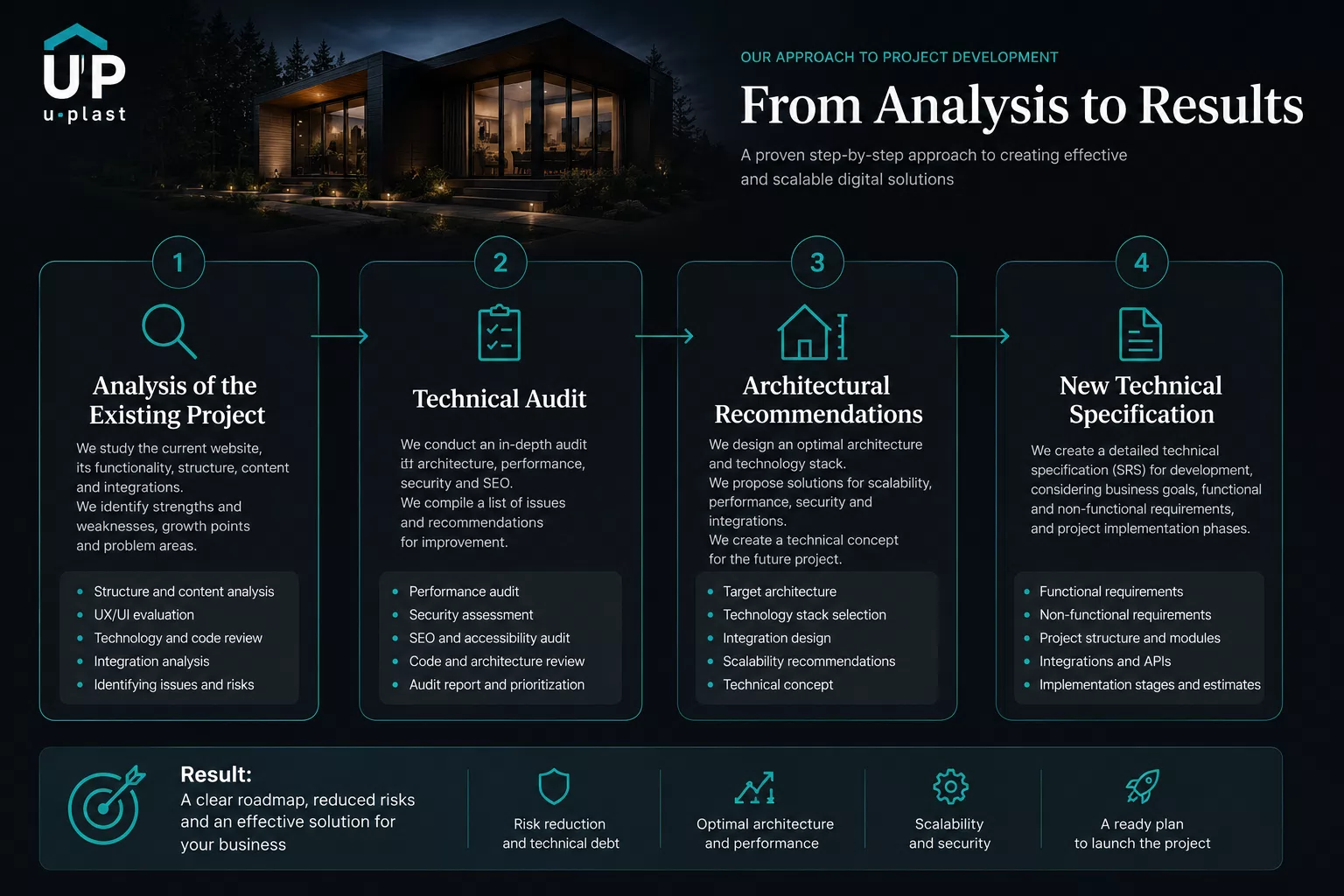
However, we made the decision to start not with programming, but with a comprehensive technical audit.
It was this stage that became the starting point of the entire project.
After a detailed analysis of the existing implementation, it became clear that the prepared WordPress theme was a quality design prototype, but not a full-fledged platform. The project architecture did not account for further scaling, many sections were placeholder stubs, there was no unified data model, and the chosen technology significantly limited the future development of the product.
Instead of refining the existing solution, we proposed completely revisiting the project architecture and creating a modern corporate platform focused on the company's long-term development.
Started not with development, but with an engineering audit
We believe that quality development begins with understanding the existing project.
Therefore, the first stage was a comprehensive technical expertise of all materials provided by the client.
As part of the audit, we performed:
- analysis of the existing corporate website;
- review of the WordPress theme and project structure;
- assessment of the data architecture;
- analysis of user scenarios;
- interface responsiveness check;
- SEO requirements analysis;
- scaling prospects assessment;
- preparation of recommendations for further project development.
It was the results of this audit that became the foundation of the new technical specification and allowed avoiding a large number of architectural mistakes even before development began.
Why we abandoned WordPress
During the analysis, it became obvious that the existing WordPress theme was well-suited for demonstrating the future design, however it did not meet the tasks of a full-fledged corporate platform.
The project included a significantly more complex data structure than a typical corporate website:
- product collections catalog;
- gallery of completed projects;
- video materials library;
- technical documentation;
- multilingual structure;
- integration with the facade visualization service;
- extended SEO infrastructure;
- proprietary administrative system.
After evaluating several options, we recommended abandoning further WordPress development and building the platform on the basis of Symfony.
This solution provided significantly greater control over the project architecture, security, performance, and the ability for further development without the limitations characteristic of typical CMSs.
Designing the new architecture
The next stage was not programming, but design.
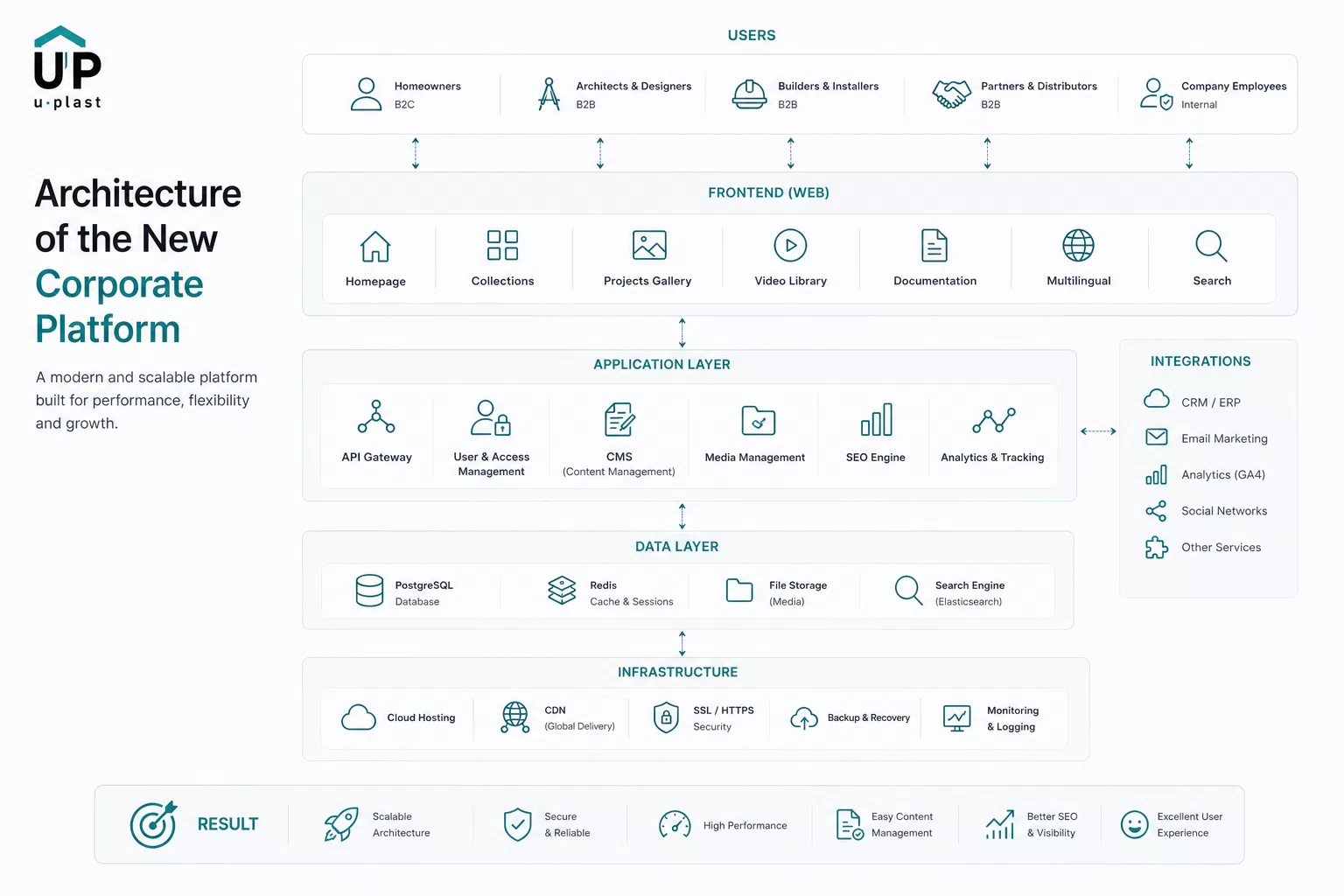
Based on the results of the technical audit, we completely reworked the structure of the future project, prepared a new technical specification, formed user scenarios, and performed a decomposition of all development stages.
As a result, a corporate platform was designed, including:
- a modern homepage with a modular structure;
- product collections catalog;
- interactive gallery of completed projects;
- video materials library;
- technical documentation section;
- multilingual architecture;
- corporate CMS;
- SEO management system;
- optimized work with media content.
Each module was designed as an independent part of the company's unified digital ecosystem.
Modern content management system
One of the key tasks of the project was to provide the company's employees with the ability to independently manage the digital platform without involving developers.
For this purpose, a corporate administrative system was implemented, allowing work with all the main project entities through a single interface.
Through the CMS, the company's employees can:
- manage website pages;
- edit the product catalog;
- publish news and articles;
- upload photos and video materials;
- manage technical documentation;
- configure SEO parameters of pages;
- automatically convert images to WebP;
- edit image metadata.
This approach significantly speeds up website updates and makes project development independent of the development process.
The engineering challenge of the project
Even a carefully designed architecture sometimes faces limitations of the existing infrastructure.
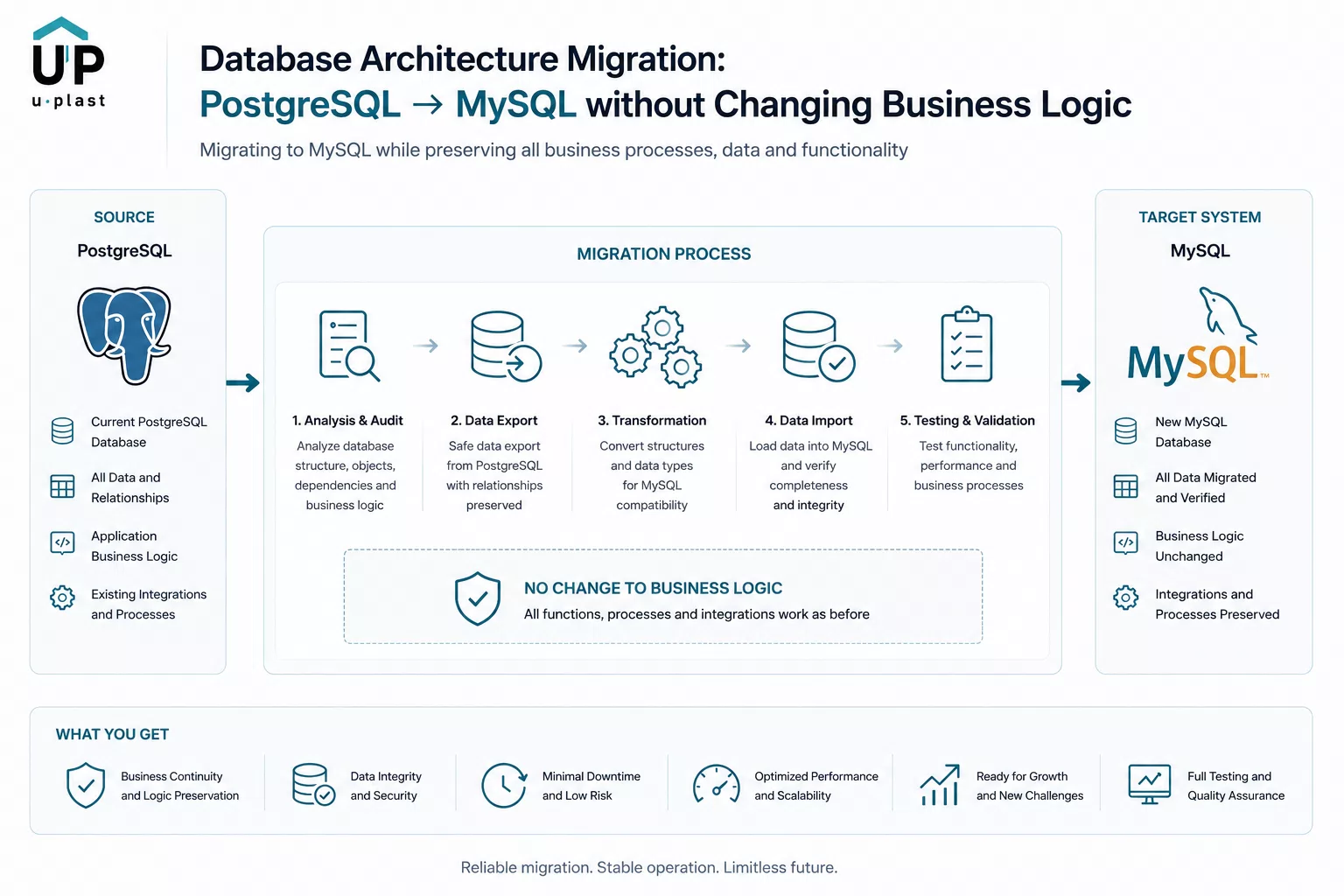
Initially, the platform was developed using PostgreSQL, since it was this DBMS that most fully matched the chosen Symfony architecture.
However, before the project launch, it turned out that the new system had to be deployed on the client's existing server infrastructure, which was entirely built on MySQL.
Instead of changing the company's infrastructure, we adapted the platform to the existing operational environment, reworking the data storage layer and database migrations without changing the application's business logic.
This approach allowed us to preserve the advantages of the chosen architecture while simultaneously ensuring compatibility with the client's existing infrastructure.