AI for client acquisition — a working scheme. Especially when you hit several pain points at once
In the first part, we broke down a simple principle: AI accelerates MVP only within a fixed hypothesis and Must-have. Without scope boundaries, it just produces extra volume faster.
The continuation is about something else: client acquisition through an AI-accelerated MVP is not theory. It's a working commercial technique. And it becomes noticeably stronger when one short release addresses not one, but several customer pains at once.
Short answer: a client more often buys the next stage not because "AI is trendy," but because at the demo they saw a solution to several of their daily problems — in a single passable scenario.
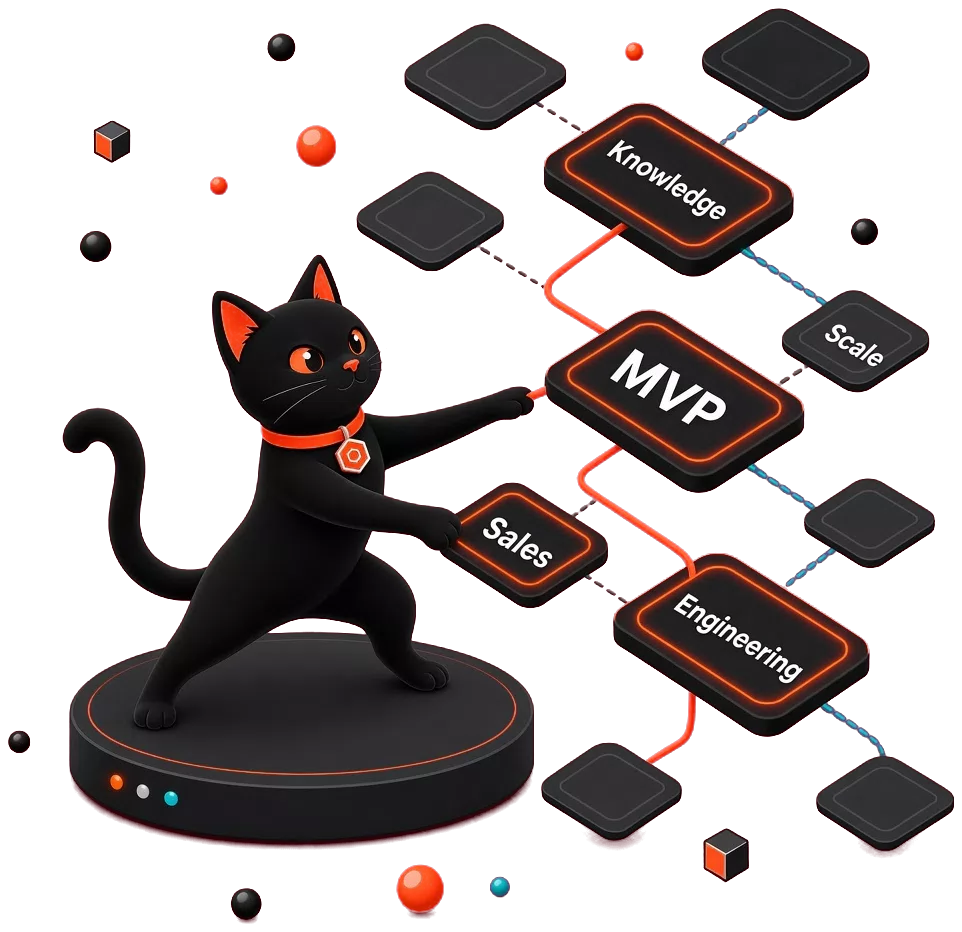
Why "one pain — one slide" is weaker than a vertical of several pains
A B2B customer almost never has one isolated problem. Usually there's a bundle:
| Pain | How it sounds at the customer | What they actually lose |
|---|---|---|
| Sales / approval | "It's hard for us to explain the value internally" | The deal stalls on slides and verbal promises |
| Operations | "We calculate in Excel, make mistakes, it's slow" | Specialists' time and defects in specifications |
| Knowledge | "Formulas live with one person in a file" | Risk of losing expertise and difficult onboarding |
| Scale | "Then also 1C / CAD / other lines" | Fear to start, because it seems "we need everything at once" |
If the MVP closes only UI "for beauty," objections remain.
If the MVP shows a calculating scenario + a clear result + a path forward — several stop-factors are removed at once.
Here AI helps not "to add a neural network to the product," but to assemble such a vertical faster: parse Excel/TZ, sketch domain rules, raise a wizard, build a demo stand.
Case: MVP for Blum hardware selection
Let's break it down on a real engineering project.
Project essence
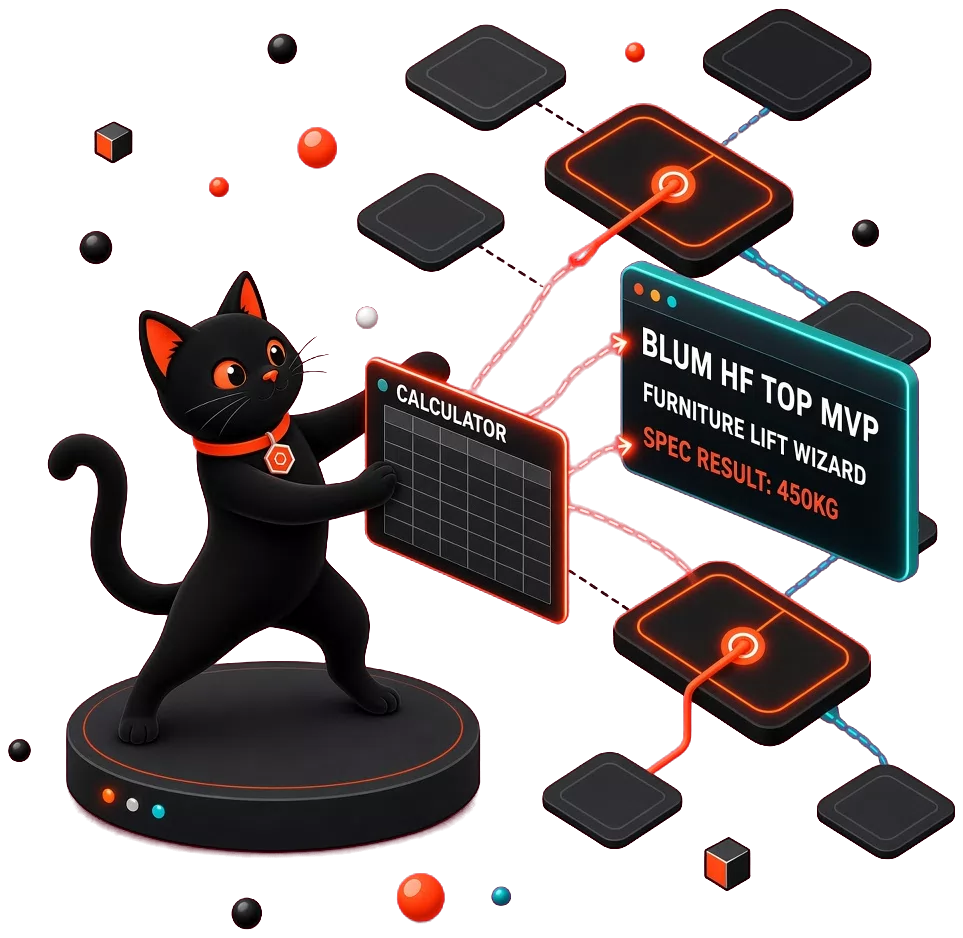
We needed to make a CPQ-type web tool for furniture production: selection and calculation of Blum hardware, primarily AVENTOS HF top lift systems.
Not a "picture catalog," but a working path:
- set project and facade parameters;
- get a calculation (load, mechanism, hinges, specification);
- see a preview;
- save the project and print the result;
- if necessary, browse the nomenclature reference.
What problem the client faced

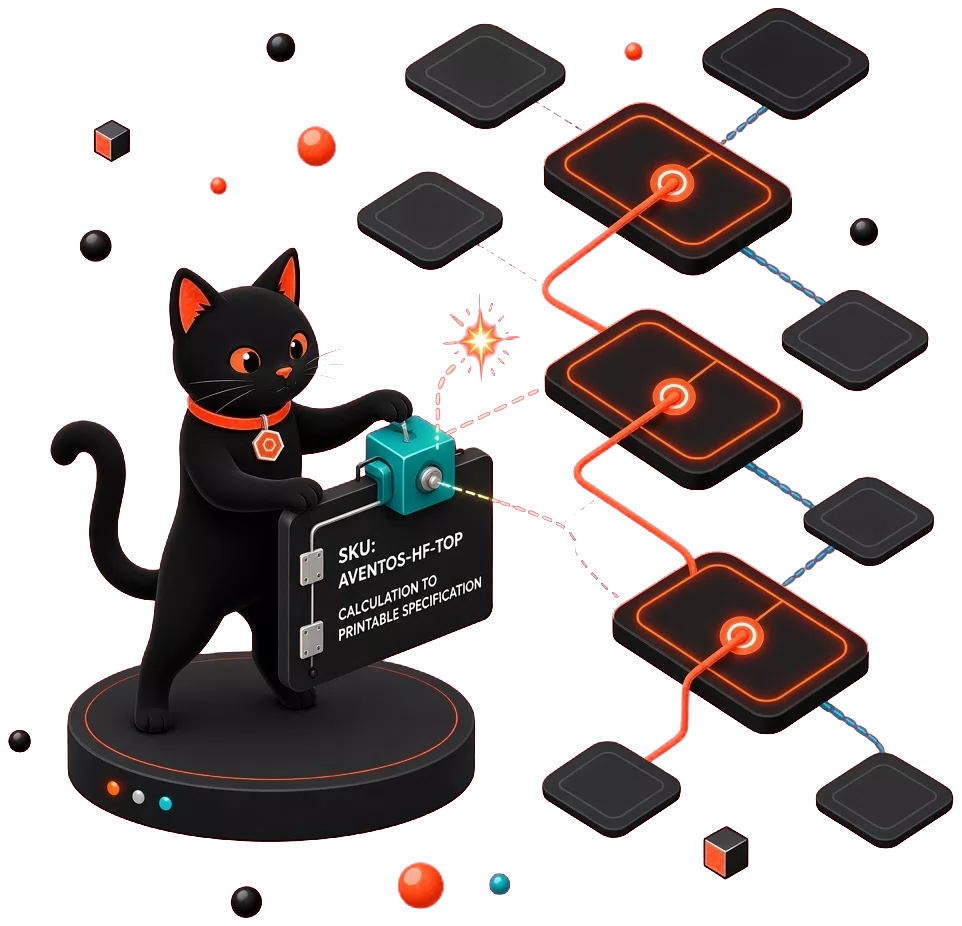
Before the digital MVP, the process looked typical for a complex subject domain:
- the key calculation lived in an Excel calculator;
- nomenclature and logic additionally relied on a PDF catalog and internal materials;
- a specialist manually transferred the result into documents;
- a full enterprise contour (all Blum lines, 1C, BAZIS, roles, audit) looked expensive and long if built "from scratch and everything at once."
That is, the pain was not only technical. It was a tangle:
| Pain direction | Specifically in the Blum project |
|---|---|
| Engineering | Hard to quickly and transparently get an HF top specification |
| Knowledge | Rules are "locked" in Excel and heads |
| Commerce / internal stakeholders | Hard to show the future solution without a working demo |
| Development | Fear that without 1C/full catalog it's pointless to start |
What hypothesis we tested with the first release
If a technologist/designer can complete the AVENTOS HF top calculation in the web in one session and get a specification without a manual Excel cycle, the customer will confirm the value of digitalization and agree to the next stage (other lines, server storage, integrations).
This is what acquisition through MVP is: not promising a platform, but showing one credible piece of value.
How AI helped hit several pains at once
AI was not a "feature for the user" in the first version. It accelerated the team's delivery contour on several fronts simultaneously.
| Customer pain | What we did in MVP | Where AI accelerated the team |
|---|---|---|
| Long/fragile calculation in Excel | Web wizard HF top + domain formula module | Draft of functions, mechanism rules, types, edge cases |
| Opaque specification | Result screen: mechanism HF 25/28/31, hinges, positions, warnings | Result UI skeleton, specification structure, state texts |
| Knowledge only in a file | Rules moved into code (calculateHfTop, mechanism table) |
Fast transfer of logic from description/Excel into TypeScript skeleton |
| Need to "touch," not listen | Demo stand (Docker / Node), project save and print | Launch wrapper, checklists, demo scenario |
| Fear of "needing everything at once" | Strict Not Now: other lines, 1C, auth, DB | Generation only within Must-have, without sprawl |
Result for the client at the demo: they see not an abstract AI pitch, but the closing of their pains — faster calculation, clearer specification, safer start without enterprise overload.
What exactly we implemented
User path
- project dashboard;
- HF top calculation wizard: project → dimensions → material → result;
- live facade preview at steps;
- save project;
- print;
- Blum reference with search and categories (demo sample).
Technical solution
| Layer | Solution in MVP | Why |
|---|---|---|
| UI | Next.js 14 (App Router), React 18, Tailwind | Quickly assemble a passable wizard |
| Domain | TypeScript module for HF top calculation | Formulas separated from screens |
| Data | Local reference + materials in code | No need to wait for integrations for demo |
| Storage | localStorage |
Close the loop "calculated → saved → printed" |
| Ops | Docker / npm run build, basic CI |
Stand is reproducible, not "only on a laptop" |
| Quality | Scripts for cross-check with Excel reference | Demo looks engineering-grade, discrepancies are visible |
Key engineering move: domain calculation is not mixed with UI.
UI collects input, the module calculates facade weight, LF, selects mechanism, assembles specification. Later this same core can be moved to an API and connected to 1C — without rewriting the wizard from scratch.
What was deliberately not included in the first release
| Deferred | Why Not Now |
|---|---|
| HK top, LEGRABOX, TANDEMBOX | First prove one scenario |
| Integrations with 1C and BAZIS | Not needed to validate demand for the web path |
| Auth, roles, audit | Enterprise horizon, not a demo hypothesis |
| Full PDF catalog as online base | Demo sample is enough for the scenario |
| Server DB | Excessive for the first experiment |
This is exactly what allowed us to quickly get a commercial effect: show value early, without drowning in a "platform for years."
How several pains strengthen the sale of the next stage
After such an MVP, the conversation with the client changes.
| Before the demo | After the demo |
|---|---|
| "We need digitalization in general" | "Here's a working HF top — let's expand" |
| "Without 1C it's too early to start" | "First we confirm the scenario, 1C is the next contour" |
| "Excel suits us" | "Web shows the specification faster and is more convenient for the team" |
| "Hard to estimate the scope" | There's a Must/Not Now boundary and a clear roadmap |
AI accelerated the build.
But sold the next stage not AI as a brand, but the closing of several pains in one short value path.
Practical framework: multi-pain MVP
If you repeat the approach on other projects:
- Build a pain map of the customer (sales, operations, knowledge, integrations, start risk).
- Choose one core path that touches 2–3 pains at once.
- Fix Must/Not Now before generation.
- Use AI for reference parsing, domain, UI, stand, demo scenario.
- Leave to humans formula acceptance, scope promises, and success criteria.
- At the demo explicitly show which pains are already closed and which are deliberately deferred.
| Good multi-pain MVP | Bad "AI MVP" |
|---|---|
| One scenario closes several pains | Many screens about no pain to the end |
| There's a reference and cross-check | "Looks like the truth" without verification |
| There's a stand via link | Only presentation and Figma |
| There's an honest Not Now | Promise "we'll do everything at once" |
Summary
Using AI for client acquisition is a working thing.
But the maximum effect comes not from code generation as such, but from assembling a short MVP that simultaneously:
- accelerates approval;
- removes operational pain;
- pulls knowledge out of Excel into a managed contour;
- shows a safe path to a large scope without the need to build everything yesterday.
The Blum case illustrates this well: instead of endless discussion of a "hardware platform," the customer got a calculating web scenario for AVENTOS HF top on a modern stack — and the foundation for the next stage already on facts, not slides.
FAQ
Do I have to mention AI when selling to the customer?
No. Often it's enough to show the speed and quality of the demo. AI is an internal delivery accelerator, unless it itself is the product's value.
Why can't we close all Blum lines at once?
Because then MVP disappears again: longer to first proof, more expensive hypothesis error. First one credible path.
What was the most important technical decision?
Separating the domain calculation from the UI and maintaining the link with the Excel reference. This gave trust at the demo and a foundation for integrations.
How do I know the multi-pain MVP worked?
If after the demo the conversation shifts from "do we need this" to "in what order do we expand" — the acquisition hypothesis worked.