In 2026, your product is not just your own code — it is dozens of connections to the outside world: payment gateways, CRMs, marketing platforms, cloud services. Every integration expands business capabilities and simultaneously creates a new entry point for attackers. A leak through an API key committed to a public repository; intercepted traffic between servers; poisoned data from an unreliable external source — the cost of a single mistake is measured not only in dollars, but in customer trust.
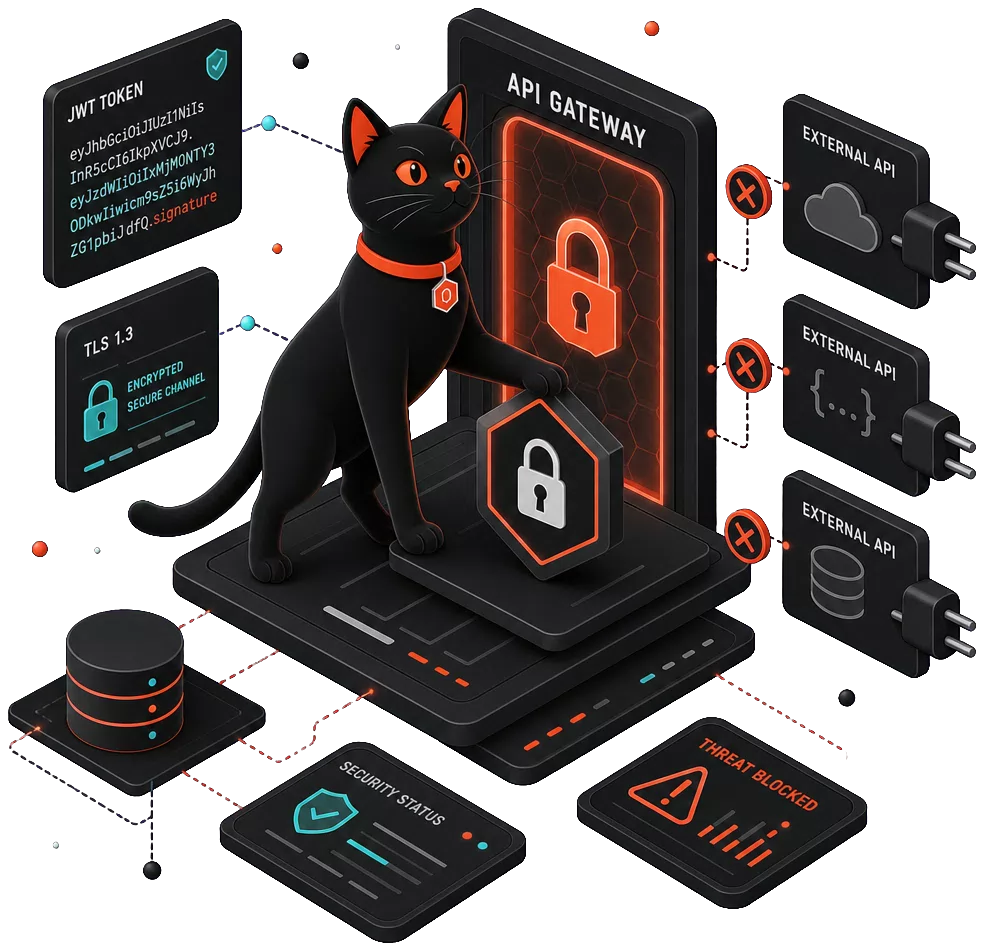
Main Threats When Working with External APIs
Unprotected secrets. API Keys and tokens in source code, environment variables without rotation, or in application logs — the most common cause of compromise. A single GitHub scan or backup leak is enough for an attacker to gain full access to your integrations.
Missing rate limits. An external service can send an endless stream of requests — deliberately or due to a failure. Without Rate Limiting and circuit breakers, your backend becomes hostage to someone else's infrastructure: API-driven DoS works quietly until the server goes down.
Authentication vulnerabilities. Expired JWTs without signature verification, tokens in URLs, sessions without device binding, weak OAuth 2.0 flows — all of these open doors to unauthorized access. OWASP API Security Top 10 lists Broken Authentication as one of the top threats.
Man-in-the-Middle. Transmitting data over HTTP or outdated TLS invites interception between your server and an external API. Especially critical for payment and personal data.
Piplos Media Security Standard
We do not bolt security on at the end — it is built into the integration architecture from day one.
Secrets management. Keys and tokens live in HashiCorp Vault or equivalent systems. They never appear in code, CI/CD artifacts, or logs. Rotation runs on schedule; access follows the principle of least privilege.
Encryption. TLS 1.3 for all in-transit connections. AES-256 for sensitive data at rest — in databases, caches, and queues. Even if storage is compromised, data remains useless without the key.
Isolation. API Gateways and proxy servers filter inbound and outbound traffic: schema validation, blocking suspicious patterns, centralized authentication. External services never talk to your backend directly — only through a controlled perimeter.
Monitoring. We log not just successful calls, but anomalies: spikes in 401/403 responses, unusual request volumes, attempts to access non-existent endpoints. Suspicious activity triggers an alert — not a post-mortem review.
Since 2012, we have designed backend systems with integrations for fintech, e-commerce, and B2B platforms — security is embedded in every layer, not added on top.
Legal Compliance: GDPR and Data Protection
Technical protection without a legal foundation is half a solution. We design integrations so that customer personal data does not leave for external services unless absolutely necessary.
Anonymization and masking. Before sending to an external API, personal data is hashed, de-identified, or replaced with pseudonyms. External services receive only what the task requires — nothing more.
GDPR compliance. We document what data is transferred, to whom, on what legal basis, and for how long it is retained. We help pass security audits and prepare documentation for regulators and partners.
DevOps practices. Our DevOps processes include dependency scanning, configuration checks, and Penetration testing before release — so vulnerabilities do not reach production alongside a new integration.
Checklist: 5 Questions for Your Development Team
Ask your developers these questions right now — the answers will show how seriously they treat integration security:
- Where are API Keys and tokens stored? If the answer is "in .env on the server" or "in the code" — that is a red flag.
- What encryption protocol is used for external calls? TLS 1.2 and below is a concern; TLS 1.3 is the standard.
- Is there Rate Limiting on inbound and outbound integrations? Without limits, one partner outage can take down your service.
- How is personal data handled before sending to external services? "We send it as-is" violates GDPR.
- Has Penetration testing been performed on the integration layer? If not — vulnerabilities were never investigated, which means they exist.
Frequently Asked Questions
Is HTTPS enough for secure integration?
HTTPS (TLS) protects data in transit — that is the necessary minimum. But secure integration also requires secrets management, input validation, Rate Limiting, monitoring, and compliance with personal data regulations. TLS alone is a lock on a glass door.
Do we need a separate audit if integrations already work?
Yes. A working integration is not necessarily a secure one. Keys may have ended up in logs three years ago, and an external API may have changed its data retention policy without notice. An audit surfaces accumulated risks before they become incidents.
How does OAuth 2.0 protect integrations better than API Keys?
OAuth 2.0 issues time-limited, scope-restricted tokens instead of permanent keys. If a token is compromised, it can be revoked without replacing the entire integration. JWT adds signature and expiration verification on every request — without hitting a session database.
How long does an integration security audit take?
It depends on the number of external connections and the depth of review. A basic audit takes from one week: integration inventory, secrets check, TLS, logging, and personal data handling review. The output is a prioritized remediation plan.
Security is not a reason for fear — it is a competitive advantage. Customers and partners trust those who protect their data systematically, not declaratively. Examples of our projects with secure integrations are in our portfolio. Ready to review your current connections to the outside world: request an API integration security audit.