Every successful product eventually hits the ceiling of its architecture. What worked for a thousand users becomes a bottleneck at a hundred thousand: deploys take hours, every change carries regression risk, technical debt slows features. The question "microservices or monolith" is about how architecture will serve the business over the next two to three years.
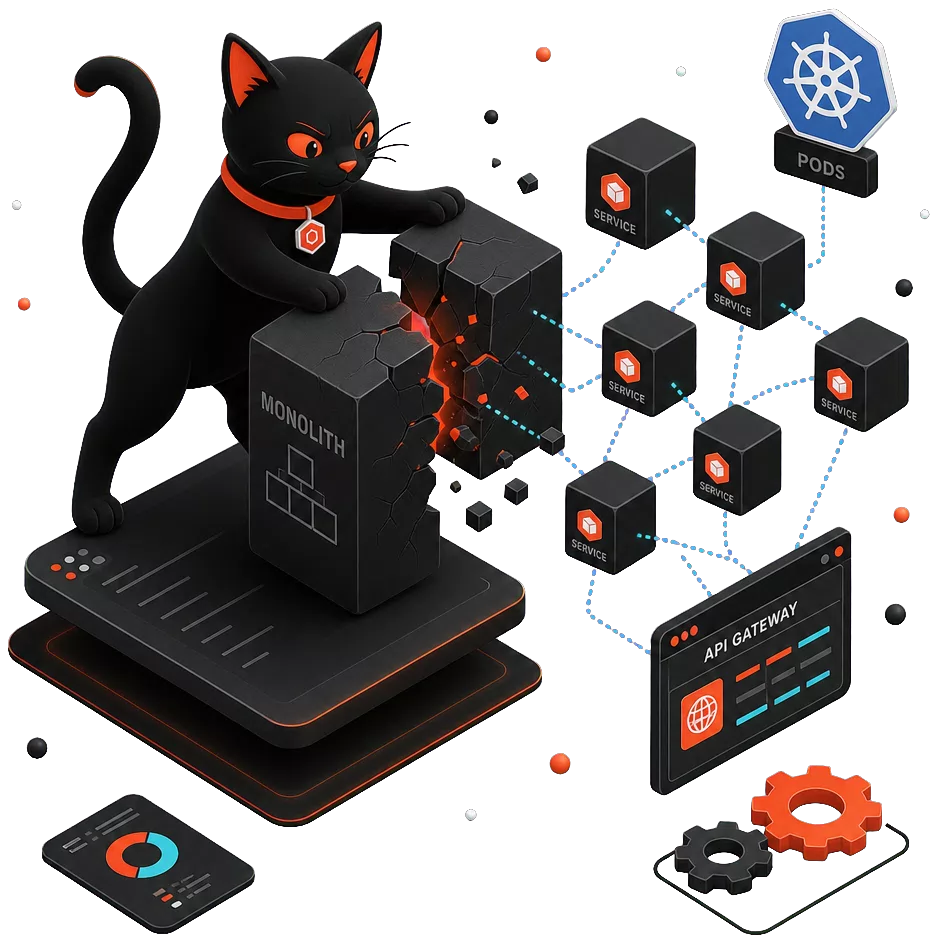
The evolutionary dead end: why architecture breaks
Behind load growth lie a bloated codebase, coupled modules, and a team stepping on each other in one repository. Vertical scaling hits a ceiling quickly. Horizontal scaling of a monolith scales the entire backend — even when only one area is under pressure.
Technical debt accumulates quietly: temporary fixes become permanent, tests slow down, onboarding stretches into weeks. CTOs and tech leads need a strategy with a clear cost of adoption and operations. At this stage it is critical to assess not only current load, but the product's growth trajectory over the next 12–18 months.
Monolith — not a verdict, but a tool
A monolith remains the best choice for startups, MVPs, and tight-budget projects. All components in one process: no network latency, ACID transactions in one database, local debugging without a dozen containers.
Advantages: development speed, simple testing, low entry barrier, predictable deploys.
The trap appears with growth: the codebase becomes a "big ball of mud," billing changes break the catalog. CI/CD swells, every release requires full-team coordination.
Microservices — freedom at the cost of complexity
Microservice architecture decomposes the system into independent services. Each owns its data (database per service), deploys separately, and scales on its own load.
Advantages: independent horizontal scaling, fault isolation, stack flexibility (Go for APIs, Python for ML), autonomous teams.
The price: orchestration via Kubernetes and Docker, network latency, eventual consistency instead of ACID (Saga pattern), Service Mesh and API Gateway. Overhead pays off only when you genuinely need scale and team independence.
Checklist: is it time to move to microservices?
Migrating "because it is trendy" is one of the most expensive mistakes. Here are signals that microservices are actually warranted:
- Developers get in each other's way — merge conflicts, code review queues, blocked releases;
- Deploys take hours and require stopping the entire service (downtime deployment);
- You need to scale one function but end up scaling the whole backend;
- The team has grown to 3+ independent groups, each responsible for its own domain;
- Different parts of the system have different load profiles — peaks differ by 10–100x;
- Fault tolerance is critical — failure isolation matters more than transaction simplicity.
If none of these resonate — a monolith or modular monolith remains the sensible choice. Event-driven architecture and API Gateway make sense as you grow, not "from day one for architectural beauty."
Our approach at Piplos Media
We do not sell microservices as the only path. We start with an audit: load profile, team structure, growth plans. Often a modular monolith is optimal — clear module boundaries with the option to extract a service later.
For microservices we choose Go: minimal memory footprint, fast cold start, strict typing. Infrastructure is a prerequisite: CI/CD, Docker, Kubernetes, monitoring. Learn more in backend development and DevOps. Since 2012 — 170+ projects, examples in our portfolio.
Frequently asked questions
Can we start with a monolith and move to microservices later?
Yes — and it is the most common scenario. The key is to establish modular boundaries from day one: separate packages, clear APIs between modules, minimal shared state. Then extracting a service is a refactor, not a rewrite.
How much does a migration to microservices cost?
It depends on system size and infrastructure maturity. Migrating a "big ball of mud" without preparation can take months and double operational costs. We start with an architecture audit to estimate real cost and priorities.
Do we need Kubernetes from day one?
No. For a small number of services, Docker Compose or managed containers are enough. Kubernetes pays off with dozens of services, autoscaling, and multiple environments — but requires investment in DevOps skills.
Why Go instead of Node.js or Python for microservices?
Go delivers predictable performance, low memory usage, and a single binary with no runtime dependencies. Node.js fits I/O-bound tasks, Python fits ML; Go is the best balance for API layers and business logic in production. Combined with Docker and Kubernetes, it lowers infrastructure cost and simplifies operations during horizontal scaling.
Architecture should serve the business, not fashion. We will help you choose a path that does not become a burden in a year: request an architecture audit.