Most IT projects exceed budget by 50–100% or shut down within a year of launch. The root cause is rarely "bad developers" — it is building without design. Development without Discovery is like erecting a skyscraper without blueprints: money drains away, deadlines slip, and the product misses the market. Discovery Phase turns an idea into a validated specification with clear economics — before you spend the main development budget.
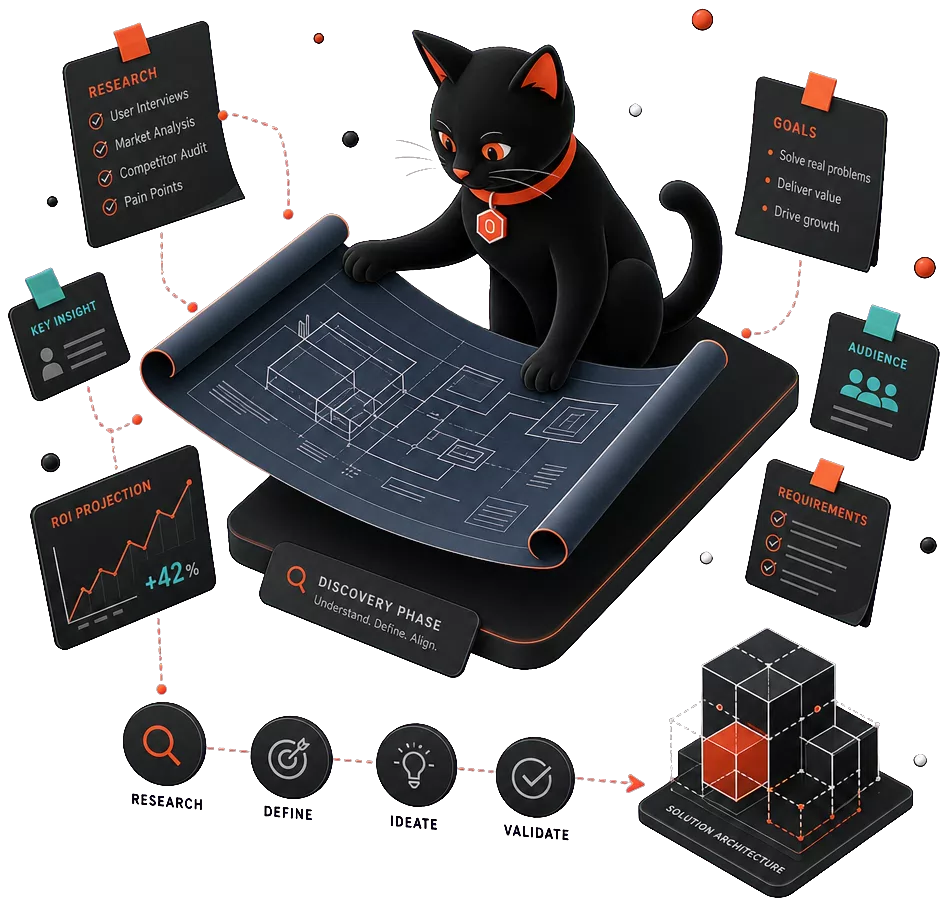
Anatomy of Discovery Phase at Piplos Media
Discovery is not "draw mockups in a week." It is a structured process that links business goals, user scenarios, and technical feasibility into one actionable plan.
1. Business analysis. We define product goals, KPIs, constraints, and success criteria. If a metric is undefined, it cannot be built into architecture or prioritised in the backlog.
2. User research. We identify user segments, jobs to be done, and usage context. User Stories and Job Stories describe concrete flows with acceptance criteria — not a vague "user dashboard."
3. Technical audit and architecture. Stack choices are evidence-based: Go for high-load APIs, Flutter for cross-platform clients, PostgreSQL or ClickHouse depending on data patterns. We document integrations and Non-functional requirements (NFR): load, SLA, security, scaling. High-level Architecture sets service boundaries before the first line of code.
4. Prototyping. Interactive wireframes validate hypotheses with stakeholders and future users. A prototype costs orders of magnitude less than rewriting production code.
The output is a technical specification you can build from — not a slide deck for sign-off. Architecture work connects to our backend expertise: we design systems we are prepared to implement.
Discovery economics: stage ROI
Changing business logic during analytics costs roughly $100. The same change after code is written and integrated — $5,000 and up: API rework, data migrations, regression testing, release delays.
Discovery surfaces "impossible" features before development starts: integrations with no public API, latency requirements that conflict with the data model, MVP features with zero ROI. That is not pessimism — it is risk mitigation.
TCO (Total Cost of Ownership). Sound architecture upfront lowers maintenance cost for years: fewer workarounds, clear module boundaries, documented NFR. Saving on Discovery means overpaying on every sprint that follows.
Why "free estimates in 15 minutes" cannot be trusted
Agencies that quote a range after one call are not analysing your product — they are selling a template. Without Discovery, estimates are guesswork: hidden integrations, uncounted edge cases, and "we assumed the API existed" surface on sprint three.
An accurate estimate and realistic roadmap are only possible after pre-project analytics. That is the honest approach: you know scope, risks, and cost before signing a development contract. We do not sell Discovery as a margin add-on — it is the only way to keep development from becoming a black box with an unpredictable invoice.
Deliverables: what you receive
- PRD (Product Requirements Document) — goals, User Stories, priorities, explicit out of scope;
- Architecture diagram — services, integrations, data flows, NFR;
- Wireframes / prototypes — key screens and flows for team alignment;
- Detailed estimate — breakdown by phase and module, not a vague range;
- Development roadmap — phases, MVP scope, dependencies, decision points.
Documents remain yours whether you continue with us or an in-house team.
Frequently asked questions
How long does Discovery Phase take?
Typically 2–6 weeks — depending on product complexity, number of integrations, and readiness of business requirements. A narrow MVP scope is faster; an enterprise platform with multiple roles and external systems takes longer — but still costs a fraction of post-launch rework.
Can we skip Discovery and start coding immediately?
You can — if you accept budget ×1.5–2 and timelines ×2. In practice, "fast start without analytics" means Discovery happens inside development — at full sprint cost and team burn rate.
Is Discovery only for startups?
No. Enterprise Product Owners, teams before a major rewrite, and investors before a funding round use Discovery for technical due diligence: a clear backlog, justified stack, transparent estimate.
Discovery is not an expense — it is an investment with immediate payback: you pay for clarity before a mistake becomes expensive. Book an intro session with our business analyst and tech lead: discuss Discovery for your product.