When your platform handles millions of requests per day, backend choice drives infrastructure cost, response time, and resilience under peak load. Go (Golang) delivers C++-level performance with simpler operations and predictable scaling. We design and build high-load APIs, microservice platforms, and fintech backends for teams that cannot afford downtime or latency spikes.
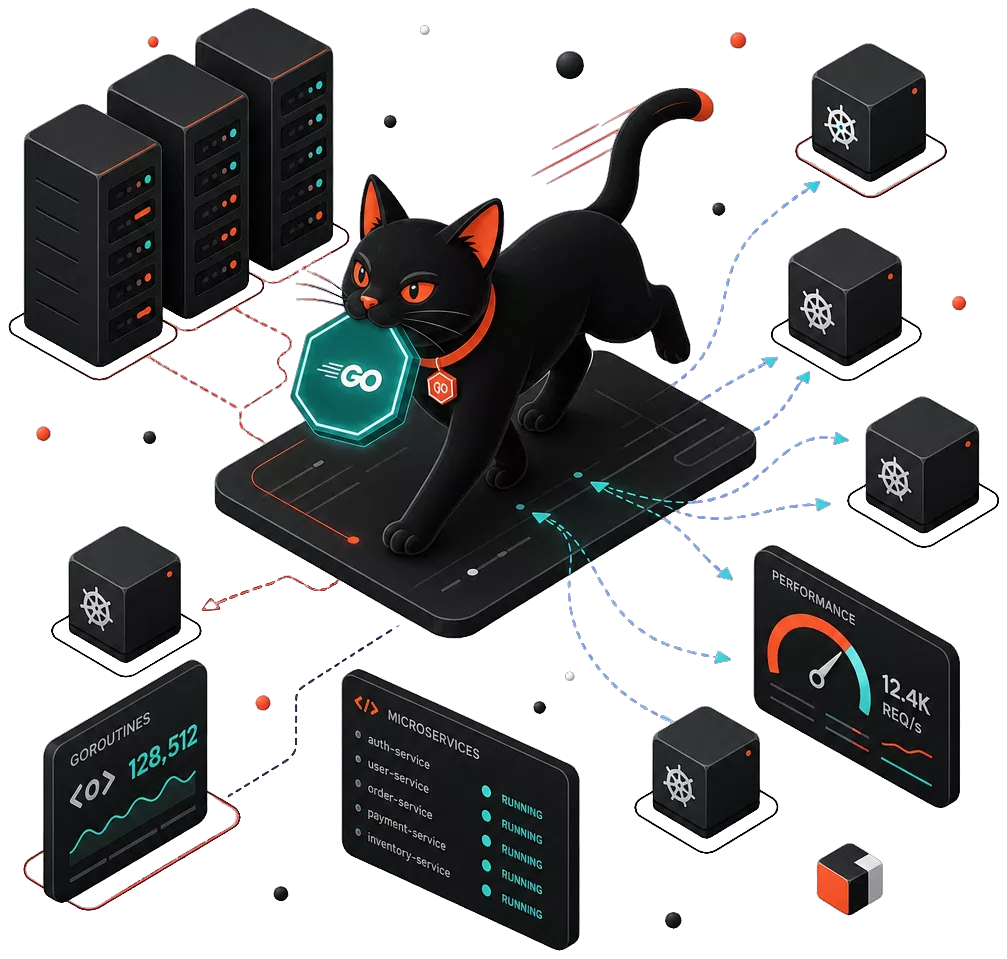
Why Go is the modern backend standard
Raw speed. Go compiles to native code and runs an order of magnitude faster than interpreted stacks. For systems with millions of users, that means fewer servers, lower cloud bills, and stable response times even during traffic peaks.
Efficient concurrency. Goroutines and channels handle thousands of concurrent connections with minimal memory overhead. Concurrency in Go is built into the language — parallel request handling, background workers, and data streaming without heavyweight abstractions.
Stability and simplicity. Strong typing, consistent formatting, and a focused standard library make long-term maintenance easier. Teams onboard faster, refactors are safer, and product growth does not turn into unmanageable technical debt.
What we build with Go
- High-load APIs and backend systems — REST, GraphQL, gRPC with documentation and versioning;
- Microservice architectures — greenfield design or phased migration from monolith without stopping the business;
- Fintech platforms and payment gateways — transactions, idempotency, audit trails, provider integrations;
- Cloud services and infrastructure software — services built for Docker and scaled with Kubernetes;
- Real-time data processing — queues, event streaming, aggregation, and cross-system synchronisation.
Full-cycle backend development — from architecture to production-ready deployment.
Piplos Media Golang expertise
Since 2012, we design architectures that survive peak load: caching, sharding, horizontal scaling, and graceful degradation when dependencies fail.
Databases. We work deeply with PostgreSQL for transactional data, Redis for cache and pub/sub, and ClickHouse for analytics over millions of events. Database choice follows the use case, not hype.
Infrastructure. We write code ready for production from day one: Docker containerisation, Kubernetes orchestration, CI/CD pipelines. DevOps practices are part of the process — we do not hand off raw code without a deployment path.
Go as the AI glue layer. We use Go between business logic and LLM services: request routing, rate limiting, response caching, pipeline orchestration. The language excels where speed and predictable resource usage matter.
Delivered solutions and tech stacks — in our portfolio.
Why work with us
- Transparent process — Agile/Scrum, regular demos, clear backlog, fixed sprints;
- Code review and automated tests — unit, integration, and load testing on critical paths;
- Security and resilience — encryption, access audit, circuit breakers, health checks, monitoring with alerts.
Frequently asked questions
Why is Go better than PHP or Python for backend?
PHP and Python are excellent for prototypes, CMS workloads, and moderate traffic. Go wins where raw performance, concurrency, and predictable CPU/RAM usage matter: APIs at thousands of RPS, microservices, fintech, real-time systems. Fewer servers — lower TCO over the long run.
Is it hard to find Go developers for maintenance?
Go is one of the most in-demand languages in infrastructure and backend engineering. Google, Uber, Docker, and the Kubernetes ecosystem rely on it. The talent market is mature — finding a team for maintenance and growth is realistic. We deliver documentation, OpenAPI specs, and a clean codebase.
When is Go NOT the right choice?
Go is not ideal for heavy CPU-bound scientific computing (C++/Rust fit better), simple low-traffic CRUD sites (overkill on development cost), or projects where Python's ML ecosystem is the primary requirement. We assess stack fit honestly before starting.
Discuss architecture and load profile with our tech lead — we will prepare an estimate and roadmap: discuss your project.