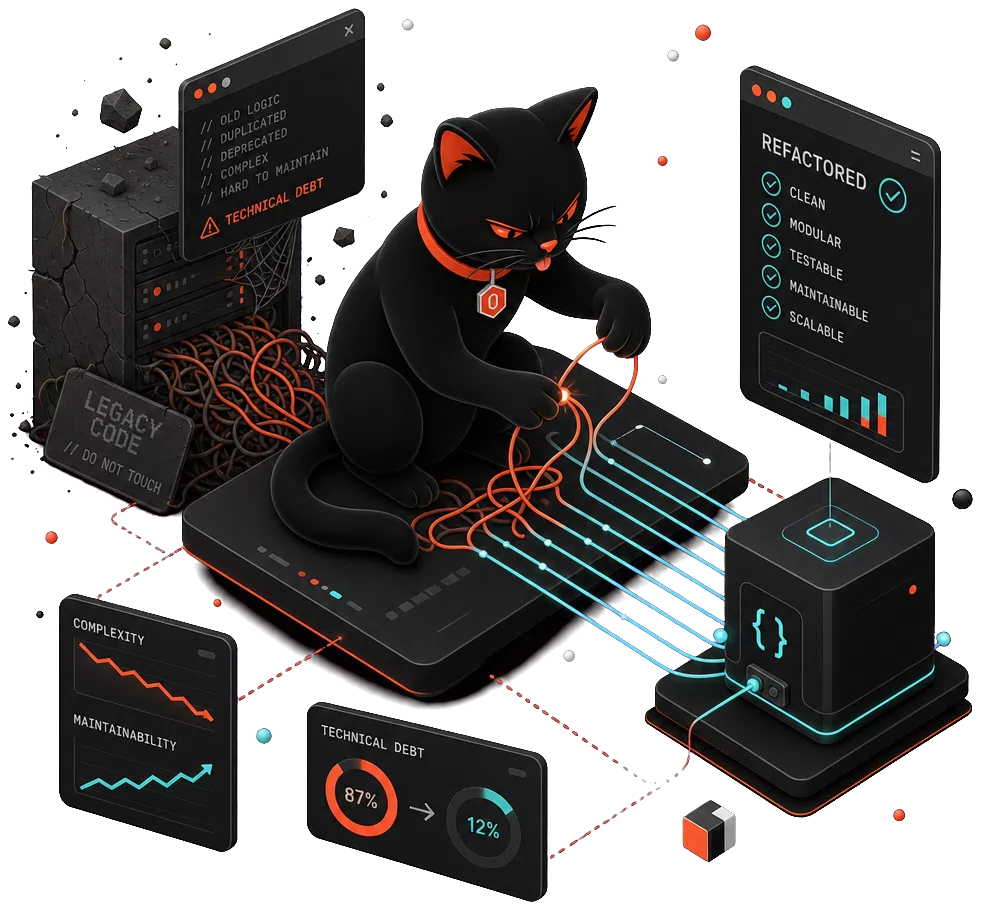
Legacy code is not just "old code." It is code you are afraid to change. On the surface, the product works, customers pay, reports balance — but inside, the foundation is cracking. Adding a button to the interface takes a month. Every fix spawns ten new bugs. The team celebrates every successful deploy like a war victory — because failure means business downtime. If this sounds familiar, your Technical Debt has moved from a technical problem to a business risk.
How to Tell When Technical Debt Becomes Critical
Time-to-market. Competitors ship features several times faster, while your team spends weeks on what others finish in days. The system does not scale with business ambitions — it holds them back.
Cost of ownership. The maintenance budget grows year over year, while the development budget shrinks. More resources go to firefighting and fixing regressions; fewer go to new capabilities for customers.
Talent shortage. Strong developers do not want to work with "dinosaurs" — outdated PHP versions, Delphi, monoliths without tests or documentation. And those who know the system inside out have already left — along with knowledge that was never written down.
Deploy fear. Releases are scheduled for Friday evening "when nobody is watching," rollbacks are prepared in advance, and Code Review becomes a ritual of mutual insurance. That is a symptom, not a workflow.
Rescue Strategies: Cut or Cure?
Option A: Greenfield (Rewrite). A full rewrite from scratch makes sense when maintenance costs exceed creation costs and business logic is well documented. Risk: long development without returns, loss of behavioral nuances, two systems running in parallel.
Option B: Incremental modernization (Refactoring). Strangler Pattern — replacing old modules with new ones one at a time, without stopping the business. A critical module is rewritten in Go or another modern stack; the old one is retired only after the new one is validated in production. Lower risk, predictable progress.
Option C: Freeze. When it is cheaper to leave legacy as-is and build new alongside — a separate service for new features, old code serving existing customers only. Works when the system is stable but not evolving.
Choosing a strategy is not a technology question — it is an economics question: cost of maintenance, downtime risk, speed to market.
Piplos Media Legacy Methodology
Audit. Deep codebase analysis: architecture, dependencies, bottlenecks, hidden risks. Not "story point estimates" — a system map with priorities: what to fix first, what can wait, what is dangerous to touch without preparation.
Test coverage. We do not change code until we are confident we understand how it works. Unit Testing on critical paths is insurance against regressions. Without tests, Refactoring becomes roulette.
Documentation. We recover knowledge that lived only in the heads of departed employees: business rules, non-obvious dependencies, historical decisions. Documentation is not a formality — it is an asset that reduces bus factor.
Safe migration. Moving data and logic without stopping business processes: parallel runs, gradual traffic switching, rollback in minutes. Customers should not notice that modernization is happening under the hood.
Since 2012, we have modernized systems for e-commerce, logistics, and B2B platforms — examples in our portfolio. Backend development in Go is one of our key tools for gradually replacing legacy modules.
Refactoring Economics: Modernization ROI
Technical Debt is a loan with interest. Every month without action, maintenance costs rise and development speed falls. Investment in code quality pays back through:
- Lower maintenance costs — fewer regressions, fewer firefighting tasks, less dependence on a single "knowing" developer.
- Faster feature delivery — clear architecture and tests shorten time-to-market from weeks to days.
- Reduced downtime risk — predictable deploys instead of fear before every release.
- Talent appeal — a modern stack and Maintainability help hire strong engineers.
Refactoring ROI is not visible in the first month — it shows over six months to a year, when the business starts moving faster than the market again, not slower.
Frequently Asked Questions
Can we modernize without stopping the business?
Yes — with the right strategy. Strangler Pattern and parallel runs allow replacing modules one at a time, switching traffic gradually. Full downtime is needed only in extreme cases — and we design the process to avoid it.
How much does a legacy code audit cost?
It depends on codebase size and analysis depth. A basic audit takes one to two weeks: architecture, risks, Technical Debt assessment, and strategy recommendations. The output is a modernization plan with priorities and timeline estimates.
When is a rewrite better than refactoring?
When maintenance costs exceed creation costs, business logic is well understood and documented, and the current architecture cannot scale. But even a Rewrite we recommend incrementally — via Strangler Pattern, not "big bang."
How do we estimate refactoring ROI before starting?
During the audit, we capture current metrics: time for a typical feature, regression frequency, maintenance vs development budget ratio. After modernizing the first modules, we compare — the difference is measurable ROI.
Old code is not a sentence — it is a challenge. We help turn your IT asset from a source of losses back into a source of profit. Request a professional code audit and get a modernization plan with priorities, timelines, and ROI estimates.