AI is no longer a pilot project — it is a practical tool that removes routine work from teams and speeds up customer-facing operations. We implement solutions built on OpenAI, Claude and local models (Llama): from chatbots to autonomous AI Agents that work with your data, not the open internet.
What we solve
Customer service. AI assistants handle routine questions around the clock, escalate complex cases to agents with full conversation context, and consistently follow company policies. Support load drops without sacrificing service quality.
Document analytics. Thousands of contracts, reviews, tickets and emails are processed in minutes: classification, entity extraction, executive summaries. The model follows your rules — it does not guess.
Sales and marketing. Smart lead magnets, personalised offers and inbound qualification — AI helps sales teams act with precision instead of replacing them.
Internal operations. Automation of reports, document drafts, code and content generation from templates. Staff spend time on decisions, not retyping the same materials.
Why Piplos Media
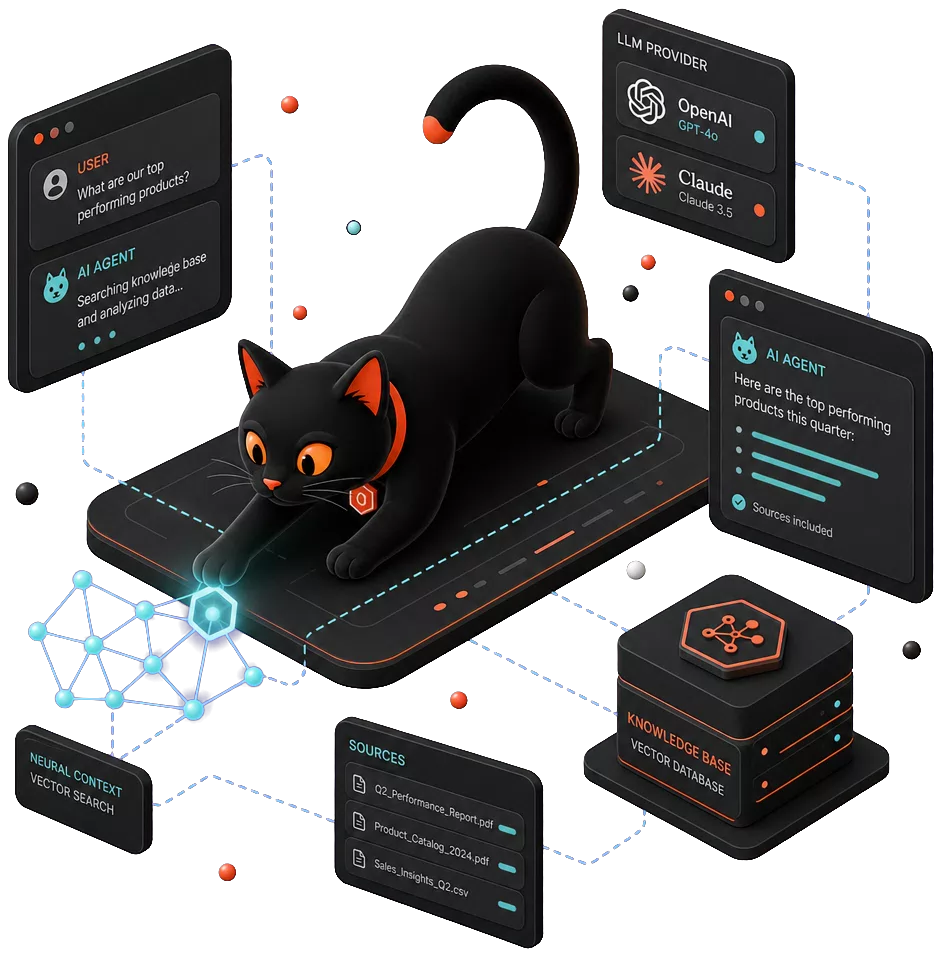
We go beyond API calls. We build systems with RAG — the model answers from your company knowledge base: policies, FAQs, product docs, CRM data. For complex workflows we design AI Agents: action chains with validation, calls to internal services and result control.
Data security is a core requirement. We configure request isolation, sensitive-data filtering, corporate API keys and retention policies. Client data never feeds public model training. When needed, we deploy local models inside your perimeter.
Since 2012 we have designed backend systems for high-load products — LLM integration fits your existing architecture instead of living as a standalone demo.
Technology stack
- OpenAI — dialogues, text analysis, content generation;
- Anthropic — long context, careful document and instruction handling;
- Google Gemini — multimodal scenarios and Google ecosystem integrations;
- LangChain — orchestration of chains, agents and tools;
- Pinecone, Milvus — vector stores for RAG and semantic search;
- Go — high-throughput API layers and integration with your services.
Model and architecture choices follow the business case and token budget — not hype. We track token consumption, tune prompts for cost efficiency and set guardrails so production usage stays predictable month to month.
How we work
- Process audit — identify where AI delivers the highest ROI, not a vanity feature.
- Prototype (MVP) — a working scenario on real data to validate answer quality before full rollout.
- Integration — connect to CRM, helpdesk, internal APIs and knowledge bases.
- Testing and tuning — system prompt iterations, quality metrics, hallucination control.
First MVP delivery starts from two weeks, depending on data volume and integrations.
Frequently asked questions
How much does LLM integration cost?
Cost combines development and ongoing token usage. During the audit we estimate payback: how many team hours automation saves and how quickly the project pays for itself. An MVP validates the numbers before major investment.
How fast can we launch?
A first working scenario — from two weeks: a simple RAG assistant over documents or integration into an existing chat. Complex multi-system agents need more time for design and testing.
Do we have to store data in the cloud?
Not necessarily. For sensitive data we use local models (Llama and equivalents), deployment in your VPC, or a hybrid setup: public API for non-critical tasks, local inference for confidential workloads. During the audit we map data flows and recommend the option that matches your compliance requirements.
See delivered projects in our portfolio. Book a free AI transformation consultation — we will review your case and outline the fastest path to production.