Most projects begin with design or development. The U-Plast project became an exception.
The client came to us with an already completed concept for the future site, preliminary materials, technical specifications, and a WordPress theme prototype. At first glance, it might have seemed that the project was at an advanced stage of readiness and required only refinement of the existing implementation.
However, the technical audit conducted revealed a completely different picture.
We found that the existing theme was merely a demonstration interface framework implementing about 35–40% of the future functionality. Most pages were placeholders, there was no full-fledged data architecture, key user scenarios had not been implemented, and the chosen technology platform limited the project's further development.
That is precisely why the decision was made not to refine the existing code, but to completely reconsider the architecture of the future platform.
The project began with a technical audit
Before starting development, we conducted a comprehensive technical review of the existing materials, including the WordPress theme, project documentation, and client requirements. This allowed us to identify the strengths of the prepared concept, uncover potential risks, and formulate a strategy for further development.
During the audit, we analyzed:
- the structure of the existing WordPress theme;
- content architecture;
- user scenarios;
- the quality of the responsive version implementation;
- scaling prospects;
- SEO requirements;
- multilingual support capabilities;
- anticipated integrations with external services.
Based on the analysis results, a detailed technical report was prepared with recommendations for the project's further development.
Why we abandoned WordPress
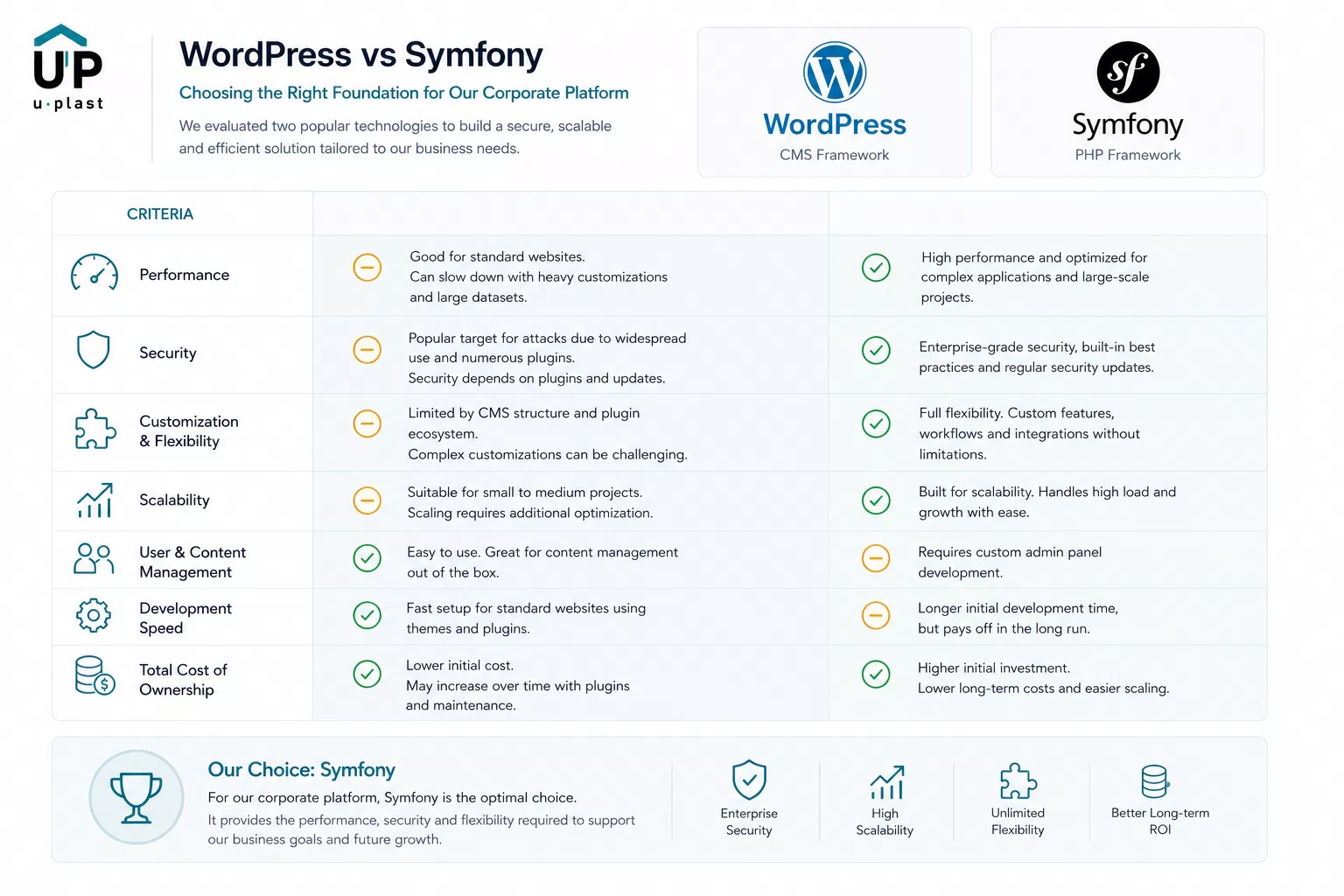
During the audit, it became evident that WordPress is well-suited as a CMS for simple corporate websites, but the architecture of the future project went far beyond the scope of a classic website.
The new platform was supposed to combine:
- a collections catalog;
- a project photo gallery;
- a video archive;
- a technical documentation library;
- a multilingual structure;
- integration with the "Design Express" service;
- SEO infrastructure;
- a modern administrative system.
Such an architecture corresponds more to a full-fledged web application than to a traditional CMS-based website.
After analysis, we recommended abandoning further WordPress development and building the project on Symfony.
This decision provided significantly greater control over architecture, security, performance, and further project scaling.
We didn't just write code — we re-engineered the entire product
The next stage was designing the new architecture.
Based on the audit conducted, we completely reworked the technical specification, formed the structure of the future site, described user scenarios, and prepared a detailed development decomposition. The technical specification included requirements for page structure, photo gallery, video sections, instructions, administrative panel, SEO module, and media content processing.
As a result, a new digital architecture for the project was formed, including:
- a modern homepage in Bento Layout format;
- a collections catalog;
- an intelligent photo gallery with filtering by materials;
- a video library organized by collections;
- a technical instructions section;
- an administrative control panel;
- an SEO settings system;
- automatic image processing.
Modern administrative system
One of the project's goals was to make the platform as independent from developers as possible.
We implemented an administrative system that allows company employees to independently manage most elements of the site.
Through the CMS, you can:
- edit page content;
- manage the photo gallery;
- publish video materials;
- upload PDF instructions;
- change the homepage structure;
- manage SEO parameters;
- automatically convert images to WebP;
- edit image metadata (ALT, Title, Description).
This approach significantly simplifies project maintenance and accelerates the publication of new content.
Special attention — performance and SEO
When designing the platform, we paid special attention to the technical quality of the site.
The project incorporated:
- automatic WebP image generation;
- SEO parameter management for each page;
- Open Graph for social networks;
- sitemap.xml generation;
- SEO-friendly page URLs;
- secure integration of external video services;
- optimized media content handling.
Thanks to this, the new platform meets modern search engine requirements and is ready for further promotion.
An unexpected challenge during development
Already after the architecture stage was completed, the project encountered a technical limitation of the client's infrastructure.
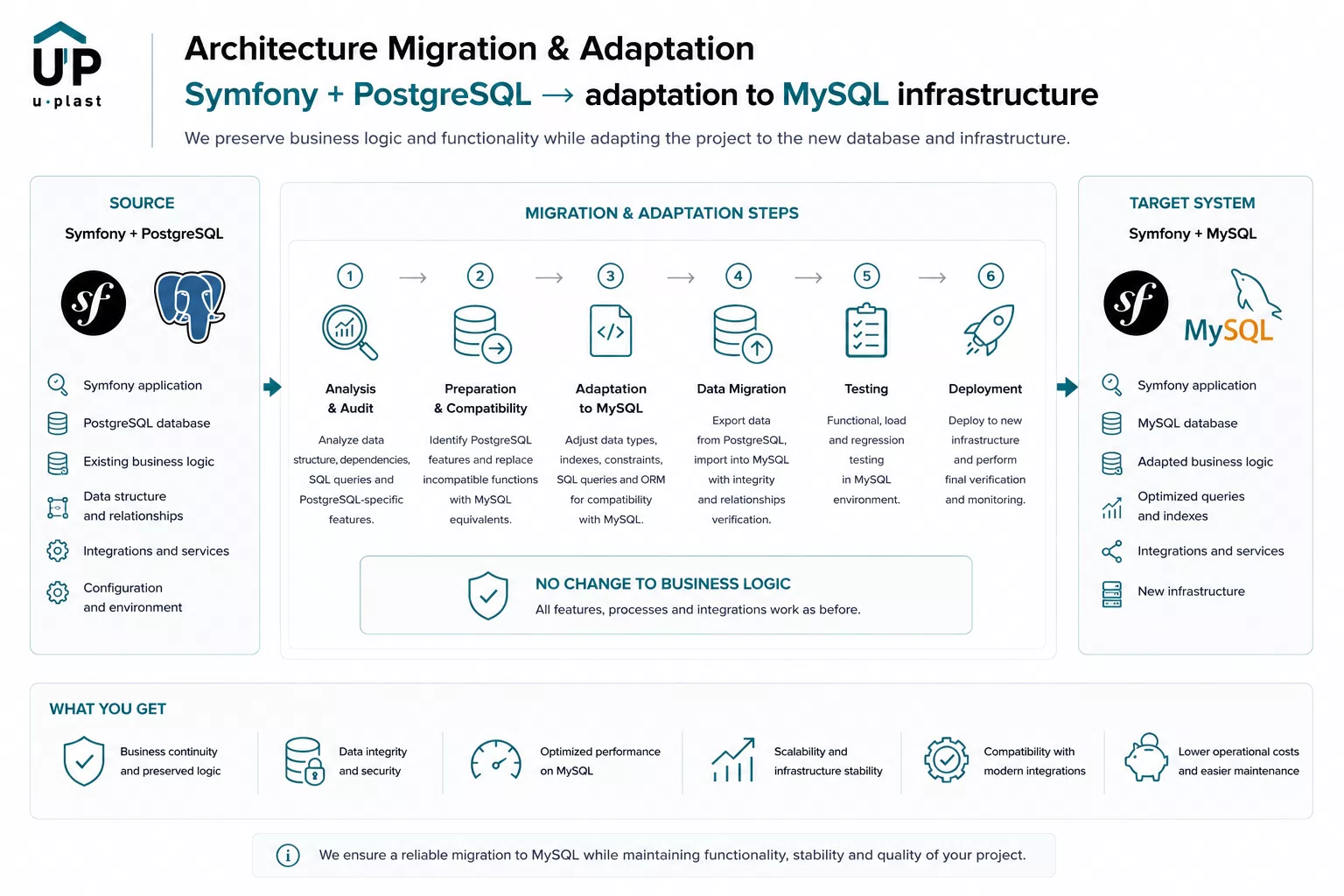
Initially, the new platform was developed using PostgreSQL, since this DBMS best matched the chosen Symfony architecture and scalability requirements.
However, during implementation it became clear that the launch had to be performed on the client's existing server infrastructure, which was entirely built on MySQL. Transitioning to a new database proved impossible without changes to the entire internal infrastructure.
To ensure compatibility with the existing environment, we adapted the project to MySQL, reworking the data storage layer and migrations without changing the application's business logic. This approach allowed us to preserve the architectural advantages of the platform while simultaneously meeting the client's deployment requirements.
This stage became a good example of how, in real projects, engineering decisions must take into account not only ideal architecture, but also the limitations of existing IT infrastructure.
Project outcome
As a result, the client received not just a new corporate website, but a modern digital platform fully prepared for further development.
The project combined a convenient content management system, scalable architecture, a modern user interface, and tools for effective work with media materials. Thanks to the preliminary technical audit, it was possible to avoid numerous architectural mistakes that would inevitably have arisen when attempting to develop the original WordPress implementation.
Today, the platform is ready for development, integration of new services, and functionality expansion without the need to reconsider the base architecture.